
2. Keyword Research & Intent Tracking
As a software blogger, your primary job is finding high-intent commercial keywords (e.g., “Best cloud hosting for developers” or “NordVPN vs ExpressVPN”).
Semrush: The Intent Champion
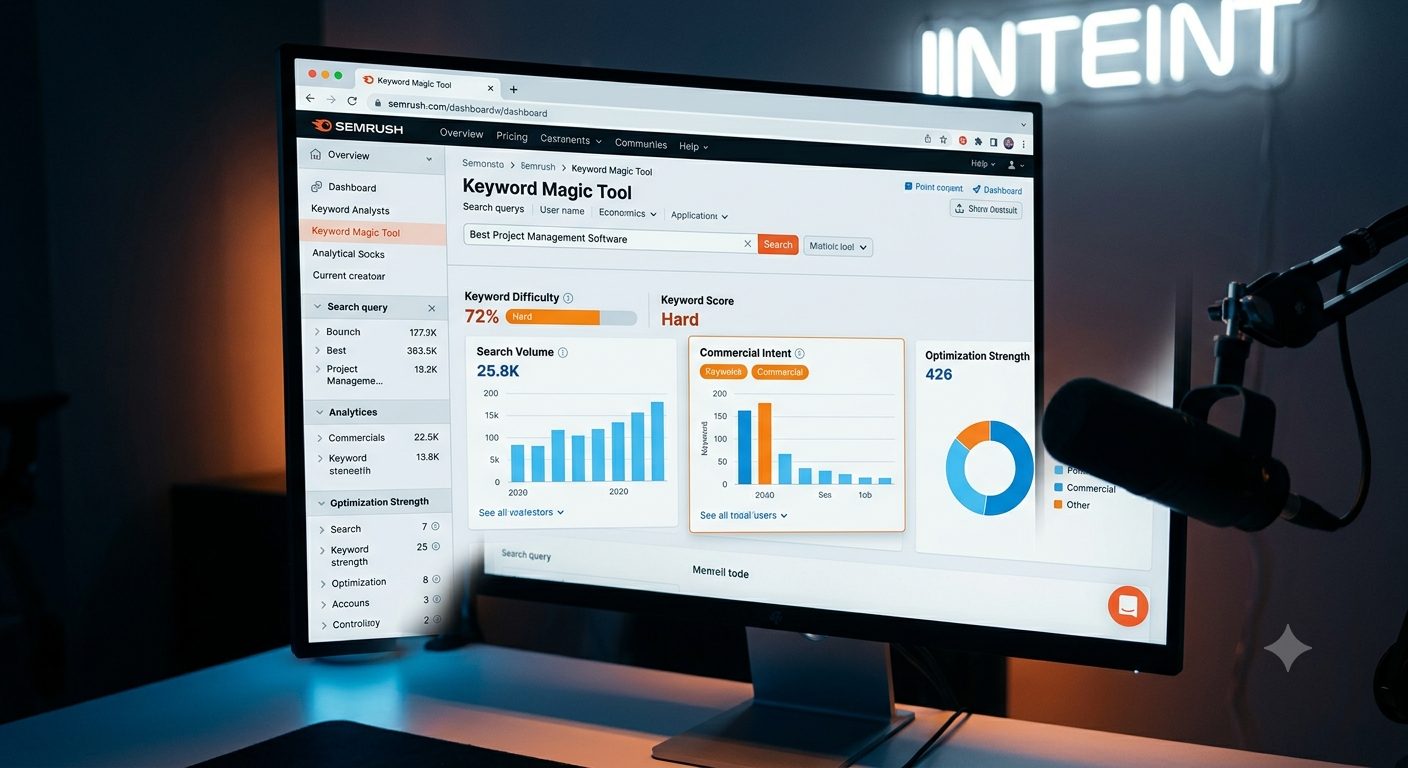
Semrush’s Keyword Magic Tool is arguably the best interface on the market for generating huge keyword lists. What makes it incredibly valuable for affiliate bloggers is its explicit Intent Filter. It automatically tags keywords as Informational (I), Commercial (C), or Transactional (T). This allows you to filter out casual searchers with one click and isolate buyers who are actively comparing software pricing or looking for discounts.
Furthermore, its newer AI Visibility tracking lets you see how often your brand or target products are mentioned within AI search engines, helping you optimize for Answer Engine Optimization (AEO) alongside standard search results.
Ahrefs: The Content Gap Master
Ahrefs handles keyword research with extreme precision via its Keywords Explorer. While it doesn’t separate intent as explicitly as Semrush, it excels at showing you total Traffic Potential—a metric that reveals the true traffic a ranking page gets across all its keyword variations, rather than just the single search term you typed in.
For a software blogger, Ahrefs’ killer feature is the Content Gap tool. You can plug in three competing tech blogs, and Ahrefs will spit out a list of every profitable software review your competitors are ranking for that your site hasn’t written yet.
Winner for Keyword Research: Semrush wins for raw volume discovery and built-in commercial intent filtering. However, Ahrefs takes a close second for its unmatched Content Gap extraction workflow.

3. Backlink Infrastructure: Tracking the Tech Niche
In the hosting and VPN space, you cannot rank for competitive terms without high-quality backlinks. Spying on your competitors’ backlink profiles to replicate their guest posts and resource links is standard operating procedure.
Referring Domain Index (Total Pool Size)
├── Ahrefs:  |||||||||||||||||||| 500 Million Domains (Winner)
└── Semrush: |||||||||||||||      390 Million Domains
- Ahrefs Site Explorer: Historically, Ahrefs has been the gold standard for backlink data. It maintains the industry’s largest index of live referring domains (500 million). Its live link-tracking crawler updates almost instantly, allowing you to see exactly when a competitor lands a new tech review or sponsor mention. The Link Intersect tool makes it simple to find tech directories linking to multiple rivals but not to you.
- Semrush Backlink Analytics: Semrush has made massive infrastructure investments and actually boasts a higher raw link count (43 trillion individual URLs). Where Semrush sets itself apart is its Backlink Audit and Toxic Link identification tool. It directly flags spammy websites linking to you and helps you build a clean file to tell Google to ignore them.
Winner for Backlink Analysis: Ahrefs. For pure link prospecting, discovering new outreach angles, and checking domain strength, Ahrefs’ index is cleaner and more intuitive.
4. Technical Site Audits
A slow or technically broken blog will not rank well on search engines. Both platforms feature automated site crawlers that look for broken links, slow-loading images, security issues, and Core Web Vitals problems.
- Semrush Site Audit: This is built like an enterprise-level control room. It groups your technical errors into distinct “Thematic Reports” (Crawlability, HTTPS, Internal Linking). It tells you precisely what is broken, how severe the error is, and provides step-by-step documentation on how to fix it.
- Ahrefs Site Audit: Ahrefs takes a highly visual approach. It assigns your blog an overall “Health Score” out of 100. It is exceptionally fast and clean, making it less overwhelming for beginners who don’t want to get lost in complex server logs.
Winner for Technical SEO: Semrush. Its programmatic breakdown of issues makes it easier to track and resolve complex crawling problems as your site scales.
5. Pricing and Entry Reality
This is where the decision becomes critical for self-funded bloggers and solo creators. Both platforms are premium tools, and they do not come cheap.
Ahrefs Pricing
Ahrefs offers a budget-friendly entry point called the Starter Plan at $29/month. This tier is perfect for a brand-new blogger because it unlocks basic keyword research and link checking for a single site without a massive financial commitment.
- Lite Plan: $129/month.
- Standard Plan: $249/month (This is the practical choice for active affiliate marketers who need to run competitor reports continuously).
Semrush Pricing
Semrush skips the micro-budget tiers entirely.
- Pro Plan: Starts at $139.95/month (drops to $117.33/month if paid annually). It gives you full access to keyword research and audits, but gates historical data and advanced content tools.
- Semrush One Starter: $199/month (combines classic SEO with modern AI visibility tracking features).
Winner for Value: Ahrefs wins for beginners due to its affordable $29 Starter plan. However, at the professional tier ($249/month), Semrush provides significantly more features per dollar because it bundles separate tools like PPC analysis and social scheduling into a single cost.
Summary: Which One Should You Buy?
Choosing between these platforms comes down to your current budget and traffic strategy:
Choose Ahrefs if:
- You are on a budget: The $29 Starter tier lets you analyze software niches without breaking the bank.
- Your strategy relies on backlinks: You plan on heavy outreach, guest posting, and studying how rival VPN and hosting blogs get their authority.
- You want an easier interface: You prefer a focused, lightning-fast layout that sticks purely to core SEO.
Choose Semrush if:
- You want a true all-in-one suite: You want your SEO tool, your blog post planner, and your competitor PPC spy tools in a single subscription.
- You focus heavily on content velocity: You want to use built-in tools like ContentShake AI to help build, analyze, and optimize review outlines directly in your platform.
- You want explicit buyer intent metrics: You want to instantly filter for transactional software keywords where readers are ready to convert.
Related Reading & Resources
Explore more guides on Pizario:
External resources:
For anyone launching a digital software, hosting, or VPN review blog, choosing the right search engine optimization (SEO) tool is the single most important infrastructure decision you will make. In this niche, affiliate commissions are highly competitive, and the difference between ranking on page one or page two of Google directly translates to thousands of dollars in monthly revenue.
For over a decade, two titans have dominated the market: Semrush and Ahrefs. However, the SEO landscape has shifted dramatically. Both platforms have introduced major updates to address AI search visibility, changed their entry-level options, and updated their pricing structures.
If you have a limited budget and need to choose just one premium suite to grow your software blog, this head-to-head comparison breaks down exactly where you should spend your money.
1. The Core Philosophy: All-in-One Dashboard vs. Specialist Scalpel
Before diving into the technical features, it helps to understand how these tools view themselves:
- Semrush positions itself as a broad marketing command center. It handles classic SEO but also includes dedicated modules for pay-per-click (PPC) ad tracking, social media management, automated content marketing, and brand tracking across AI platforms like ChatGPT and Gemini.
- Ahrefs functions like a specialized research scalpel. While it has expanded its suite over the years, its core focus remains data purity, hyper-accurate backlink metrics, and deep competitor search forensics.
If you plan to run paid Google ads or need built-in AI writing assistants, Semrush offers immediate value. If your strategy relies entirely on organic search, finding low-competition keywords, and executing backlink outreach, Ahrefs is heavily favored by SEO purists.

2. Keyword Research & Intent Tracking
As a software blogger, your primary job is finding high-intent commercial keywords (e.g., “Best cloud hosting for developers” or “NordVPN vs ExpressVPN”).
Semrush: The Intent Champion
Semrush’s Keyword Magic Tool is arguably the best interface on the market for generating huge keyword lists. What makes it incredibly valuable for affiliate bloggers is its explicit Intent Filter. It automatically tags keywords as Informational (I), Commercial (C), or Transactional (T). This allows you to filter out casual searchers with one click and isolate buyers who are actively comparing software pricing or looking for discounts.
Furthermore, its newer AI Visibility tracking lets you see how often your brand or target products are mentioned within AI search engines, helping you optimize for Answer Engine Optimization (AEO) alongside standard search results.
Ahrefs: The Content Gap Master
Ahrefs handles keyword research with extreme precision via its Keywords Explorer. While it doesn’t separate intent as explicitly as Semrush, it excels at showing you total Traffic Potential—a metric that reveals the true traffic a ranking page gets across all its keyword variations, rather than just the single search term you typed in.
For a software blogger, Ahrefs’ killer feature is the Content Gap tool. You can plug in three competing tech blogs, and Ahrefs will spit out a list of every profitable software review your competitors are ranking for that your site hasn’t written yet.
Winner for Keyword Research: Semrush wins for raw volume discovery and built-in commercial intent filtering. However, Ahrefs takes a close second for its unmatched Content Gap extraction workflow.
3. Backlink Infrastructure: Tracking the Tech Niche
In the hosting and VPN space, you cannot rank for competitive terms without high-quality backlinks. Spying on your competitors’ backlink profiles to replicate their guest posts and resource links is standard operating procedure.
Referring Domain Index (Total Pool Size)
├── Ahrefs:  |||||||||||||||||||| 500 Million Domains (Winner)
└── Semrush: |||||||||||||||      390 Million Domains
- Ahrefs Site Explorer: Historically, Ahrefs has been the gold standard for backlink data. It maintains the industry’s largest index of live referring domains (500 million). Its live link-tracking crawler updates almost instantly, allowing you to see exactly when a competitor lands a new tech review or sponsor mention. The Link Intersect tool makes it simple to find tech directories linking to multiple rivals but not to you.
- Semrush Backlink Analytics: Semrush has made massive infrastructure investments and actually boasts a higher raw link count (43 trillion individual URLs). Where Semrush sets itself apart is its Backlink Audit and Toxic Link identification tool. It directly flags spammy websites linking to you and helps you build a clean file to tell Google to ignore them.
Winner for Backlink Analysis: Ahrefs. For pure link prospecting, discovering new outreach angles, and checking domain strength, Ahrefs’ index is cleaner and more intuitive.
4. Technical Site Audits
A slow or technically broken blog will not rank well on search engines. Both platforms feature automated site crawlers that look for broken links, slow-loading images, security issues, and Core Web Vitals problems.
- Semrush Site Audit: This is built like an enterprise-level control room. It groups your technical errors into distinct “Thematic Reports” (Crawlability, HTTPS, Internal Linking). It tells you precisely what is broken, how severe the error is, and provides step-by-step documentation on how to fix it.
- Ahrefs Site Audit: Ahrefs takes a highly visual approach. It assigns your blog an overall “Health Score” out of 100. It is exceptionally fast and clean, making it less overwhelming for beginners who don’t want to get lost in complex server logs.
Winner for Technical SEO: Semrush. Its programmatic breakdown of issues makes it easier to track and resolve complex crawling problems as your site scales.
5. Pricing and Entry Reality
This is where the decision becomes critical for self-funded bloggers and solo creators. Both platforms are premium tools, and they do not come cheap.
Ahrefs Pricing
Ahrefs offers a budget-friendly entry point called the Starter Plan at $29/month. This tier is perfect for a brand-new blogger because it unlocks basic keyword research and link checking for a single site without a massive financial commitment.
- Lite Plan: $129/month.
- Standard Plan: $249/month (This is the practical choice for active affiliate marketers who need to run competitor reports continuously).
Semrush Pricing
Semrush skips the micro-budget tiers entirely.
- Pro Plan: Starts at $139.95/month (drops to $117.33/month if paid annually). It gives you full access to keyword research and audits, but gates historical data and advanced content tools.
- Semrush One Starter: $199/month (combines classic SEO with modern AI visibility tracking features).
Winner for Value: Ahrefs wins for beginners due to its affordable $29 Starter plan. However, at the professional tier ($249/month), Semrush provides significantly more features per dollar because it bundles separate tools like PPC analysis and social scheduling into a single cost.
Summary: Which One Should You Buy?
Choosing between these platforms comes down to your current budget and traffic strategy:
Choose Ahrefs if:
- You are on a budget: The $29 Starter tier lets you analyze software niches without breaking the bank.
- Your strategy relies on backlinks: You plan on heavy outreach, guest posting, and studying how rival VPN and hosting blogs get their authority.
- You want an easier interface: You prefer a focused, lightning-fast layout that sticks purely to core SEO.
Choose Semrush if:
- You want a true all-in-one suite: You want your SEO tool, your blog post planner, and your competitor PPC spy tools in a single subscription.
- You focus heavily on content velocity: You want to use built-in tools like ContentShake AI to help build, analyze, and optimize review outlines directly in your platform.
- You want explicit buyer intent metrics: You want to instantly filter for transactional software keywords where readers are ready to convert.
Related Reading & Resources
Explore more guides on Pizario:
External resources: