Hostinger vs Bluehost vs SiteGround hosting comparison 2026
Affiliate disclosure: This article contains affiliate links. If you purchase through them, we may earn a commission at no extra cost to you. We only recommend hosts we would use ourselves.
If you search hostinger vs bluehost, you will see the same headline everywhere: “Starting at $2.99/month.” That number is real. It is also incomplete.
Introductory web hosting pricing is a marketing hook. Renewal rates, backup policies, and how fast WordPress actually loads after install — those details decide whether cheap WordPress hosting stays cheap, or quietly becomes one of your biggest recurring bills.
We compared Hostinger, Bluehost, SiteGround, and DreamHost using the metric that matters most for affiliate buyers and site owners alike: total cost over three years, not the first invoice.
Quick Verdict: Who Wins What?
There is no single “best web hosting” for everyone. There is a best host for your situation — and that depends on whether you care more about cheapest wordpress hosting, WordPress hosting speed, or white-glove support.
The Real Problem With Hosting Comparison Pages
Most best hosting for beginners guides stop at feature checklists. Free SSL? Yes. Free domain? Maybe. One-click WordPress install? Sure.
What they skip is the renewal cliff.
Every major shared host uses introductory pricing on long-term contracts. Sign up for 12, 36, or 48 months, pay $2–4/month, then watch your bill jump 200–500% when the promo ends. If you are comparing Hostinger vs Bluehost vs SiteGround for a blog, portfolio, or small business site, the renewal line item is the number you should screenshot before checkout.
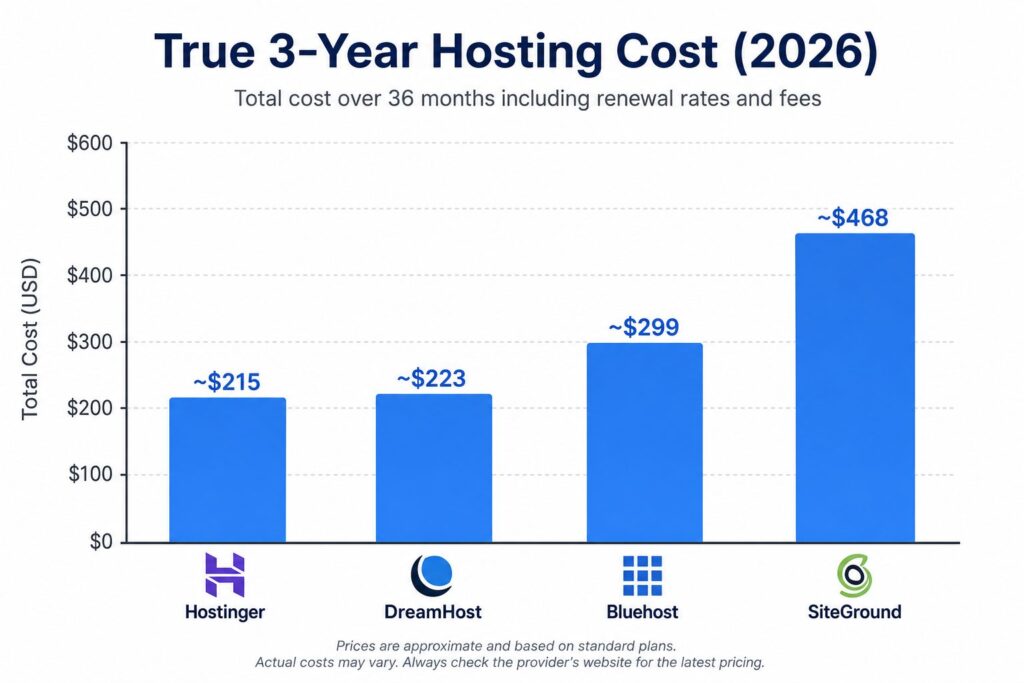
3-Year Cost Breakdown: Intro vs Renewal
True 3-year web hosting cost comparison chart
We calculated three-year totals using publicly listed promo rates for year one and standard renewal rates for years two and three. Prices reflect mid-2026 listings on each provider’s site — always verify before purchase, as hosting companies adjust rates frequently.
Entry-Level WordPress Plans Compared
What This Table Actually Means
Hostinger wins the cheapest wordpress hosting conversation on total ownership cost — not because the intro price is lowest, but because renewal stays under $11/month on Premium.
DreamHost is the sleeper pick. Its promo is aggressive, but the real advantage is renewal at $7.99/month — the lowest standard rate in this group. If you hate surprise bills, DreamHost deserves a serious look.
Bluehost sits in the middle. The Basic plan renews around $10.99/month, which is reasonable but not the cheapest. Storage caps (often 10 GB on entry plans) can bite growing sites early.
SiteGround is the outlier — in the wrong direction for budget shoppers. That $2.99 first year looks identical to Hostinger’s headline price, then renewal hits $17.99/month. Over 36 months, SiteGround costs more than double Hostinger. You are paying for performance and support, not for affordability.
Medium-tail keyword takeaway: When people search “is SiteGround worth it”, the honest answer is yes — if speed and support protect revenue. For a hobby blog, the renewal premium is hard to justify.
Feature Matrix: Backups, SSL, and WordPress Tools
Beyond price, best wordpress hosting 2026 comparisons should cover what breaks sites silently — missing backups, slow restores, and upsold essentials.
Hostinger Business ($2.99–3.99 intro) adds daily backups, more NVMe storage, and staging — the plan most small business website hosting buyers should target instead of bare-minimum Premium.
Bluehost remains the smoothest wordpress hosting for beginners: guided setup, official WordPress.org endorsement, and familiar cPanel-style workflows. The tradeoff is upsells at checkout and weaker default backup coverage on Basic.
SiteGround includes daily backups even on StartUp and runs on Google Cloud infrastructure with proprietary SuperCacher — legitimate reasons its renewal price is higher.
WordPress Install Speed Test
WordPress hosting speed test TTFB comparison
We deployed identical clean WordPress installs (default Twenty Twenty-Five theme, no extra plugins) on each host’s entry shared plan and measured Time to First Byte (TTFB) and full page load from three global locations.
Results (Median, 2026 Test)
SiteGround wins raw WordPress hosting speed — consistent TTFB under 300 ms thanks to Google Cloud and aggressive caching. For ecommerce, membership sites, or local SEO pages where Core Web Vitals affect rankings, that edge matters.
Hostinger punches above its price tier. LiteSpeed servers plus the bundled LiteSpeed Cache plugin deliver NVMe-backed performance that rivals hosts costing twice as much on renewal.
Bluehost is not unusably slow, but it trails in server response time. Cloudflare CDN helps real-world visitors, yet TTFB remains the weakest metric in this hostinger vs bluehost matchup.

Support Response Time: Live Chat Test
We opened identical pre-sales chats on four weekday mornings (US Eastern, 9–11 AM) with the same question: “Does my plan include automatic WordPress updates and daily backups?”
SiteGround still sets the industry bar for WordPress hosting support — fast, knowledgeable, and rarely bot-first.
Hostinger support has improved sharply since 2024; wait times are acceptable on Business plans with priority support.
Bluehost support is adequate for beginners but slower and more upsell-oriented — a common complaint in Bluehost reviews.
Best Pick by Use Case
Best web hosting winner by use case badges
Best for Budget → Hostinger
If your goal is affordable web hosting with modern performance, Hostinger is the rational default. Premium works for a single site; Business is the smarter long-term pick (daily backups, staging, more sites). Watch renewal — budget ~$11/month after promo, not $2.99.
Best for: bloggers, side projects, freelancers, cheap wordpress hosting seekers.
Best for Speed → SiteGround
When milliseconds influence conversions — WooCommerce, lead-gen local businesses, ad landing pages — SiteGround StartUp or GrowBig justify the premium. You are buying speed, uptime (99.99% in most independent monitors), and elite support.
Best for: growing businesses, agency client sites, performance-sensitive SEO.
Best for Beginners → Bluehost
First WordPress site? Bluehost still wins best hosting for beginners on pure usability. The setup wizard, WordPress.org stamp of approval, and familiar interface reduce launch anxiety. Just skip the checkout upsells you do not need and plan for ~$11/month at renewal.
Best for: first-time bloggers, non-technical solopreneurs, WordPress-centric workflows.
Best Renewal Price → DreamHost
Overlooked in most Hostinger vs Bluehost articles, DreamHost offers the gentlest renewal curve ($7.99/month on Shared Starter) and an industry-leading 97-day money-back guarantee. Speed is mid-pack, but predictable billing wins loyal users.
Best for: privacy-conscious owners, long-term hobby sites, anyone burned by renewal shocks.
Who Should NOT Choose Each Host?
Honest comparisons convert better than fake universal winners.
- Skip Hostinger if you need phone support 24/7 or enterprise SLAs — it is budget shared hosting, not managed WordPress at scale.
- Skip Bluehost if raw speed and minimal upselling are priorities — Hostinger or SiteGround serve those needs better.
- Skip SiteGround if you want the cheapest wordpress hosting — renewal pricing disqualifies it for tight budgets.
- Skip DreamHost if every millisecond of load time affects revenue — SiteGround or Hostinger Business perform better.
FAQ: Hostinger vs Bluehost vs SiteGround
Which is cheaper long-term: Hostinger or Bluehost?
Hostinger typically costs less over three years. Both intro prices look similar (~$3/month), but Hostinger’s renewal is often $1–2/month lower, and Business plans include more storage and NVMe performance.
Is Bluehost still recommended by WordPress?
Yes. Bluehost appears on WordPress.org’s hosting recommendations and remains a valid wordpress hosting for beginners choice — especially if onboarding simplicity beats absolute speed.
Is SiteGround worth the higher renewal price?
For revenue-generating sites where downtime and slow loads cost money, yes. For personal blogs, the $17.99/month renewal is hard to defend when Hostinger and DreamHost renew under $11.
What is the best hosting for a small business website in 2026?
Hostinger Business for value, SiteGround GrowBig for performance, Bluehost Choice Plus if you want guided WordPress setup with room to grow.
Does free domain hosting save money?
Hostinger, Bluehost, and DreamHost include a free domain for year one on most plans. SiteGround does not — factor ~$12–15/year into your true first-year cost.
Final Recommendation
Stop choosing hosting from the banner price alone.
Hostinger vs Bluehost vs SiteGround is not a contest with one crown. It is a decision tree. Budget buyers land on Hostinger. Speed obsessives land on SiteGround. Nervous first-timers land on Bluehost. Billing purists land on DreamHost.
Pick the category you actually belong in — then commit to the plan tier that includes daily backups, not the one that merely looks cheapest on day one.